
Contractor website design
The roofer Googlecouldn’t see.
Three Stone Roofing had more than 550 Google reviews and a website that was asking Google to look away.

By Michael Blair, co-owner ·
More about Michael
The short answer
On September 18, 2026, five days before we replaced Three Stone Roofing’s website, we found every page of the old one that loaded normally telling Google not to list it. The company had more than 550 reviews at 4.9 stars and held #1 on the map for roofers in Nashville, so nothing looked wrong from outside, and nobody knew. Good contractor website design starts with being findable. The new site went live September 23 and scored 98 on our scan where the old one scored 56, and by November 4 Google had indexed 69 of its 72 pages.
The call
What did Three Stone think was wrong with its website?
Three things, and none of them was the one we ended up finding. Three Stone came to us because they were unhappy with their web design company. Getting a response was a problem, the site performed poorly, and it didn’t look like a roofing company with more than 550 Google reviews at 4.9 stars.
They’re based in Franklin, Tennessee, and they do residential and commercial roofing. Their customers had already done the hard part by saying so in public. What they wanted from us was a website built to turn a visit into a call, so we started building one.
September 18, 2026
What did we find five days before the switch?
A tag telling Google to stay away. The new site was already built and passing its checks when we read the old site’s pages, and every page that loaded normally carried a robots tag reading “noindex, nofollow” in its code.
Google is plain about what that tag does. When its crawler reads one, its guide to blocking indexing says Google will “drop that page entirely from Google Search results”, and links from other sites don’t save it.
So we looked from the outside. A search for site:threestone.com came back empty, twice. Google says that search doesn’t always list everything, which is why we trust the page source first, but an empty answer for a whole domain tells you plenty. Search the company’s own name and Yelp came first. The one threestone.com result was the Smyrna page, down at #4.
Meanwhile their Business Profile still held #1 in the map pack for “roofers nashville tn”, so from the outside nothing looked broken.
Nobody could say who did it or when. Archived copies of the home page show no such tag as late as June 11, 2026, so it arrived some time in the three months after that. The tag, together with a dead sitemap at /wp-sitemap.xml, is what one checkbox in WordPress produces: Discourage search engines from indexing this site, on the Reading Settings screen. WordPress’s sitemap code reads that same setting. We can’t prove that box is what happened here. We can tell you it’s one click, and that nothing rings when somebody makes it.
We took corrective measures and fixed it right away. Nobody knew about it or how it happened.Michael Blair, co-owner
September 19, 2026
How did the old site do on a phone?
Badly. Our scan the next day put numbers on the complaint from the first call: 56 out of 100, with 11 failures. On a phone, the largest thing on the home page took 22.3 seconds to show, against the 2.5 seconds or less that web.dev asks for. Google scored mobile performance at 53 out of 100.
The home page had no main heading and no meta description, the site had no sitemap at /sitemap.xml, and all four baseline security headers were missing.
The one thing that scan didn’t report was the tag. That check joined our scanner a week later, on September 26, and it has looked for the tag on every site it has read since.
The decision
Why not just untick the box?
Unticking that box would have fixed one setting. It wouldn’t have fixed the site. The old site was on a clunky, slow, outdated WordPress platform, so we started from scratch for a better design, faster speeds, and a site that’s more reliable and safer from hackers.
There’s no WordPress to update now and no plugins to patch: it’s hand-written HTML and CSS on Cloudflare’s network. Plugins accounted for 91% of the 11,334 new WordPress vulnerabilities Patchstack logged in 2025, so having none removes that whole category.
It’s also AI friendly now. OpenAI’s GPTBot, ClaudeBot and PerplexityBot are allowed in, and there’s an llms.txt for the language models to read.
- Our scan
- The old site: 56 of 100, 11 failures
- The new site: 98 of 100
- Largest thing on the home page, on a phone
- The old site: 22.3 seconds
- The new site: 2.4 to 2.7 seconds
- “noindex, nofollow” on public pages
- The old site: Every page that loaded normally
- The new site: Gone
- Main heading on the home page
- The old site: None
- The new site: One
- Meta description
- The old site: None
- The new site: Yes, 159 characters
- Sitemap at /sitemap.xml
- The old site: None
- The new site: 72 URLs
- Baseline security headers
- The old site: All four missing
- The new site: All four set
The old site was scanned September 19, 2026 and the new one September 24. The new site’s phone load is PageSpeed’s reading from September 26.
September 23, 2026
What has to survive when a contractor changes websites?
Every old address, every ad page and every tracking tag. On September 22 we listed 156 old URLs. Of those, 118 carried the tag, 29 were returning 503 errors from the old host, 8 redirected already and 1 was a comments feed. On the new site, 7 keep their address and 141 now redirect, which is the job Google’s site-move guidance describes: map each old address to its new one, then answer with a permanent redirect from the server.
The two ad landing pages were rebuilt field for field, and the company’s Google Tag Manager, Google Ads tag and Meta pixels came across with them.
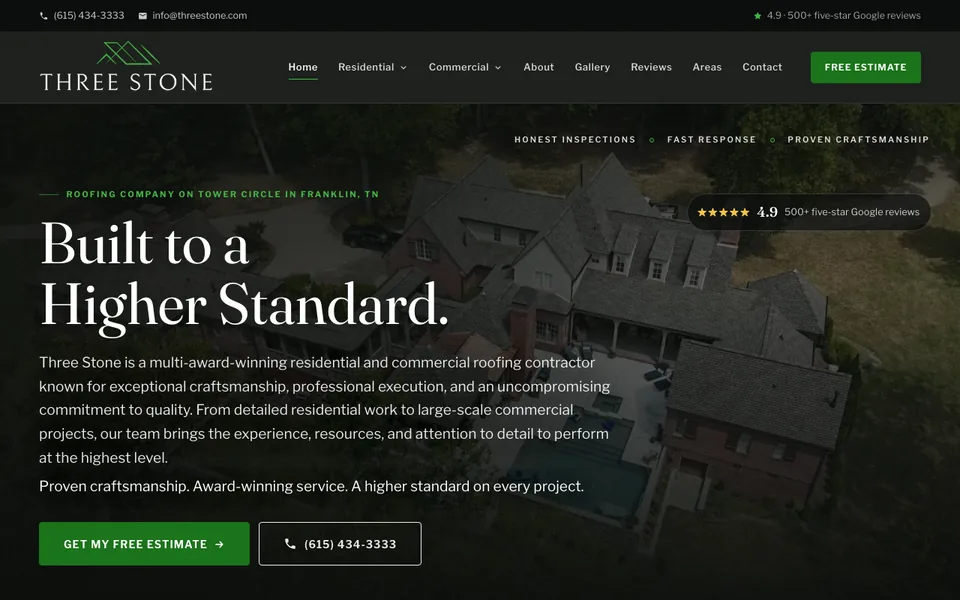
The new site went live on the evening of September 23, five days after we found the tag. The tag was gone.
Since the switch
What has happened since the launch?
Google came back a page at a time, and the work kept going. The launch wasn’t the end of it: we keep doing Three Stone’s on-page and off-site SEO and AIO, the work that gets a business into AI answers.
On October 7, two weeks after launch, Google had indexed 20 of the site’s 72 pages. We sent the core pages in for indexing, and by November 4 it was 69 of 72.
Google clicks went from 193 in the old site’s last four weeks to 241 in the latest four full weeks, and we’re still working to pass the 278 the old site had in the summer before it slid. How much of that slide came from the tag, we can’t tell you. The timing fits, and timing isn’t proof. Clicks on the website’s own Google listings went from 79 to 148 in those same weeks. We also audited all 119 domains linking to them, one by one.
Those are search numbers, and I’d read them as only that: who found the site and clicked.
What Google shows
- Pages indexed, of 72
- Then: 20, on October 7
- Latest: 69, on November 4
- Google clicks in four weeks
- Then: 193, August 26 to September 22
- Latest: 241, October 5 to November 1
- Clicks on the website’s own listings
- Then: 79, August 26 to September 22
- Latest: 148, October 5 to November 1
From Three Stone’s Search Console and Business Profile records. The summer’s four weeks, July 27 to August 23, had 278 Google clicks.
Your site, today
What should you check on your own website today?
Whether it’s asking to be left out. Search Google for site: and your domain, with no space. Then open your home page, view its source and search that for the word noindex. If it’s on a page you want customers to find, call whoever runs your site before you do anything else today.
Then look past Google’s blue links, because AI visibility is a must. When Google shows an AI summary, Pew Research found people click a traditional result on 8% of visits, against 15% without one.
So use our free scanner and see if AI likes your site. It checks the things that decide whether an assistant can read you at all: whether your pages tell search engines to stay away, the same tag that hid Three Stone, whether the AI crawlers can get in, and whether your business is spelled out in structured data.
It reads your site. It won’t tell you what ChatGPT says about you; for that we ask the engines your customers’ questions and record the answers. If you’d rather have a person look, tell us which site is yours and Michael will call you back.
AI Visibility is a must! Use our scanner and see if AI likes your site.Michael Blair, co-owner
Answers
Contractor website questions
How do I hire someone to build a website for my contracting business?
Ask to see a live site they built, then ask what happens to your old addresses before anything else. Three Stone’s old site had 156 of them. Ask who owns the accounts, how fast they answer, and what they measure before launch. A good builder has plain answers ready.
Can one WordPress setting hide a whole website from Google?
Yes. The Reading Settings screen has a box labeled Discourage search engines from indexing this site, and since version 5.3 it writes a noindex, nofollow tag. It takes one click. We can’t prove that box hid Three Stone’s site, but its pages looked exactly that way.
How long does it take Google to index a new website?
Weeks, going by Three Stone’s record, and that’s one site rather than a rule. Two weeks after its launch, Google had indexed 20 of its 72 pages. We sent the core pages in through Search Console on October 7, and four weeks later Google had 69 of the 72.
Should I fix my old website or start over?
Fix it if one setting is the whole problem, and start over if the setting is the least of it. Three Stone’s old site also took 22.3 seconds to show its main content on a phone, scored 56 of 100 and was missing all four baseline security headers.
Does a contractor website have to be on WordPress?
No. Three Stone’s new site is hand-written HTML and CSS on Cloudflare’s network, so there are no plugins for anyone to patch. Its main content on a phone went from 22.3 seconds to under 3, and its score on our scan went from 56 to 98 of 100, with no content system behind it.
Where every number came from
Sources
- Google Search Central: Block Search Indexing with noindex
- Google Search Central: The site: search operator
- Google Search Central: Site moves with URL changes
- WordPress.org Documentation, updated June 8, 2024: Settings Reading Screen
- WordPress Developer Resources: WP_Sitemaps::sitemaps_enabled()
- web.dev, updated September 4, 2025: Largest Contentful Paint
- Patchstack, February 25, 2026: State of WordPress Security in 2026
- Pew Research Center, July 22, 2025: Google users are less likely to click on links when an AI summary appears
- OpenAI: Overview of OpenAI crawlers
- Three Stone’s numbers: our own scans of September 19 and 24, 2026; PageSpeed, September 26; our URL inventory of September 22; Search Console and Business Profile records through November 4; archived copies of the old home page through June 11, 2026